

Introduction: The Agony of a World Without “Why”
Let me tell you about a feeling. It’s the late-night, you’re staring at a page of complex equations, your study lamp casting long, lonely shadows across your desk, and you feel a cold, hollowing knot of dread in the pit of your stomach. You can do the math. You can follow the steps. You can get the right answer. But you have absolutely no idea what any of it means. You are a soldier, perfectly trained in the mechanics of your weapon, but you have no idea what war you are fighting, or why.
I have been there. I have lived in that quiet, desperate state of mathematical alienation for years. I was a “good” math student. I got the good grades. I could integrate, I could differentiate, I could solve the differential equations. But I was a fraud. I was a high-level calculator, a human machine that could follow a set of instructions, but I had no deep, intuitive, or foundational understanding of the beautiful, elegant, and often terrifying world of pure mathematics. I was fluent in the grammar of math, but I was completely deaf to its poetry.
It’s a frustrating, demoralizing, and deeply isolating experience. You feel like you are on the outside of a secret, looking in. You hear the whispers of the real mathematicians, the ones who talk about the beauty of a proof, the elegance of a theorem, and it feels like they are speaking a different language, a language that you will never be able to understand.
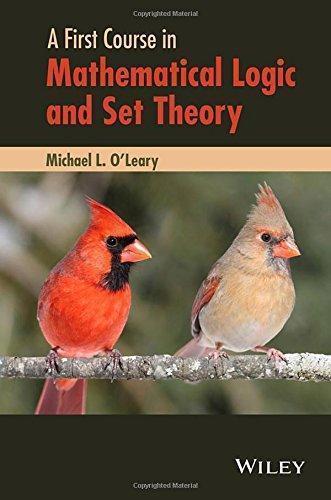
It was in that state of complete and utter frustration, of feeling like a tourist in my own field of study, that I was forced to confront a subject that I had, until then, successfully avoided: Mathematical Logic. And the book that was placed in my hands, a book with a title that was both simple and deeply intimidating, was A First Course in Mathematical Logic and Computability.
This wasn’t just another textbook full of problems to solve. This was a promise to finally, finally pull back the curtain. This was a journey into the very foundations of mathematics itself. It was a promise to stop talking about the “how” and to start, for the very first time, asking the big, scary, and beautiful “why.” Why is a proof a proof? What does it mean for something to be “true”? What are the absolute limits of what we can compute? It felt less like a course and more like an initiation into the secret, mystical order of real mathematicians.
The Philosophy: From Solving Problems to Building Worlds
I was skeptical, of course. My brain is hardwired to be. I had always seen logic as a dry, boring, and almost trivial subject. I needed to understand the philosophy behind this book. Was this just more of the same, or was it a different way of thinking about mathematics itself?
The core idea, as I came to understand it, was a profound and deeply humbling paradigm shift. The philosophy of this book is that mathematics is not the study of numbers. It is the study of formal systems. It is the art and science of building entire, self-contained, and logically consistent universes out of nothing more than a set of axioms and a set of rules of inference.
This was a gut punch. I had spent my entire life believing that math was about finding the right answer. This book was telling me that that was a childish and deeply unsophisticated view. The real game was in proving that the answer was not just right, but that it was necessarily true within the confines of the system you had built.
The philosophy is that a deep, rigorous, and almost painfully precise understanding of the language of logic is the foundation of everything. The book doesn’t just teach you how to do a proof; it forces you to build the very machinery of proof itself, from the ground up. You learn about propositional logic, about predicate logic, about the deep, and often mind-bending, relationship between syntax (the symbols on the page) and semantics (the meaning of those symbols).
It’s about teaching you to think like a logician. It’s about learning to see the world not as a collection of facts, but as a series of propositions that can be tested, that can be proven, and that can be combined to build a beautiful, elegant, and unshakeable edifice of truth.
And it’s about the profound and deeply intertwined relationship between logic and computability. It’s about understanding that the very same formal systems that allow us to prove a mathematical theorem are the ones that form the foundation of the entire digital world. The computer you are reading this on right now is nothing more than a physical manifestation of the abstract, and beautiful, principles of mathematical logic.
What’s Inside: A Guided Tour of the Foundations of Reality
So what does this journey of understanding actually look like? The book is not just a collection of chapters; it is a carefully structured, and deeply challenging, guided tour of the entire, abstract, and beautiful world of mathematical logic and the theory of computation.
The journey starts, as it should, with the absolute foundational principles of propositional logic. This is the bedrock. You learn about the basic building blocks of logical arguments—the propositions, the connectives, the truth tables. But you don’t just learn them; you are forced to use them, to build complex proofs, to develop a deep, intuitive feel for the rhythm and the flow of a logical argument.
Then, you move into the more powerful and more expressive world of first-order logic, or predicate logic. This is where you are introduced to the quantifiers, the variables, the relations. This is where you learn how to formalize not just simple statements, but complex, mathematical ideas.
And then, just when you think you are starting to get your bearings, the book takes you into the deep, and often deeply strange, waters of computability theory. This is where the abstract world of logic meets the real world of machines. You learn about Turing machines, about the Halting Problem, about the profound, and deeply humbling, limits of what can be computed. You learn that there are problems, real, well-defined mathematical problems, that no computer, no matter how powerful, will ever be able to solve.
And the beauty of it is in its rigor. This is not a book that holds your hand. It is a book that respects your intelligence. It expects you to do the work, to wrestle with the problems, to get frustrated, to fail, and to ultimately, through that struggle, to achieve a level of deep, and deeply satisfying, understanding. It is a book that doesn’t just teach you logic; it turns you into a logician.
The Benefits: More Than Just a Mathematical Education
So what are the real, tangible benefits of going on this difficult, and often mind-bending, journey? It’s not just about getting a good grade in a required course. It is about a complete and total transformation of your entire intellectual operating system.
The most obvious benefit is that you will finally understand what mathematics is really about. You will stop seeing it as a collection of disconnected rules and formulas, and you will start to see it as a beautiful, elegant, and deeply creative act of world-building.
The second benefit is a massive increase in your critical thinking and problem-solving skills. The relentless focus on rigor, on precision, and on logical deduction will train your brain to think in a way that is more clear, more powerful, and more effective than you ever thought possible. This is a skill that will serve you in every single area of your life, from your career to your personal relationships.
The third benefit is intellectual humility. This is the big one. The journey into the world of logic and computability is a journey to the very limits of human reason. You will learn about Gödel’s Incompleteness Theorems, the profound and deeply unsettling discovery that there are true mathematical statements that can never be proven. You will be forced to confront the fact that there are real, and permanent, limits to what we can know. And that is a humbling, and deeply necessary, experience for any true thinker.
And the biggest benefit of all, for me, was a newfound sense of awe. The world of mathematics, which had once seemed so dry and so boring, was suddenly revealed to be a place of incredible, and almost unimaginable, beauty, of profound mystery, and of deep, philosophical truth.
Who Is This For? The Aspiring Thinker
So who is this really for? After living with this book, after having my entire relationship with a subject I thought I knew transformed by it, I can tell you exactly who needs to have this on their desk.
This is for the mathematics undergraduate, the one who is tired of just solving problems and who is ready to finally understand the deep, foundational principles of their chosen field.
This is for the computer science student, who needs to have a deep, and rigorous, understanding of the theoretical foundations of computation, of the very limits of what a computer can and cannot do.
This is for the philosophy student, who is interested in the nature of truth, of logic, of reason itself.
And this is for the curious mind, the lifelong learner, who is not afraid of a real, intellectual challenge, and who is ready to have their mind bent in the most beautiful and rewarding way possible.
This is not for the person who is just looking for a list of formulas to memorize. This is for the person who wants to understand. This is for the person who is not afraid to think. This is for the person who is ready to see the world with new, and much more insightful, eyes.
Conclusion: The End of the “How”
So here I am. The days of being a frustrated, and ultimately unfulfilled, human calculator are a thing of the past. “A First Course in Mathematical Logic and Computability” is more than just a textbook. It is a complete, A-to-Z, and battle-tested blueprint for understanding the very foundations of reason itself.
It is a declaration of independence from the tyranny of the “how” and a full-throated embrace of the beautiful, and often challenging, world of the “why.” With its clear, rigorous, and deeply insightful approach, it is, in my honest and battle-tested opinion, one of the single most important and game-changing books that any serious student of science, of mathematics, of computer science, or of philosophy can ever read. If you are a student, a teacher, or just a curious human being, and you are tired of the confusion, the frustration, and the superficiality of just knowing how to do something, then this is the answer you’ve been looking for. It is the end of the calculation. And it is the beginning of a smarter, more profound, and more beautiful relationship with the world of ideas.
Related products